Walk into most optical shops and you will find frames stamped out by the thousands in factories across East Asia — perfectly serviceable, competitively priced, and designed to be replaced within a year or two. Then there is Lunor. The independent German manufacturer has spent more than three decades building eyewear the way it was done before globalization flattened the industry, and their approach has not changed: small batches, skilled hands, and a stubborn refusal to cut corners. At The Last Optical, Lunor is one of the brands our patients return to again and again — not because it follows trends, but because it outlasts them.
The company's own hashtag, #sloweyewear, is not marketing language. It is a manufacturing reality. Each Lunor frame passes through up to 200 individual production steps and at least eight pairs of hands before it reaches a patient's face. The workshop in the Black Forest region of Baden-Württemberg — operated by LUMAG, the Lunor Manufaktur Gesellschaft, founded in 2018 — produces between 50 and 75 frames per day. For context, a large-scale factory might produce that many in minutes.
The Rivet Hinge: Engineering That Outlives Fashion
If there is a single detail that defines Lunor's approach, it is the rivet hinge. Unlike the spring hinges found on most contemporary frames — which rely on a coiled mechanism that eventually fatigues and loosens — Lunor's hinge is milled from solid material and secured with real rivets to both the temple and the front. There is no spring to wear out, no tension to lose over time. The result is a hinge that maintains its precise, satisfying click for decades rather than months.
More importantly, the rivet hinge is designed to be repaired. If a rivet eventually does wear — after years of daily use — it can be re-riveted by an optician, restoring the frame to its original condition. This is not an afterthought; repairability is engineered into every Lunor frame from the product development stage. The company keeps spare parts available long-term for exactly this purpose, embodying a philosophy they articulate simply: "A Lunor can and should be repaired. It is worth preserving."
Ten Days to a Finish
The surface quality of a Lunor frame is immediately apparent when you hold one — and the reason becomes clear when you understand the process behind it. Glossy frames undergo a ten-day finishing process that begins with drum polishing and concludes with individual hand polishing on a buffing wheel. Each frame is finished one at a time, a practice the company describes as "glasses by glasses."
For their frosted finishes, the process is different but equally labor-intensive: each frame is individually hand-frosted using fine glass beads applied through precision sandblasting. The result is a matte texture with a depth and consistency that machine-only processes cannot replicate. Run your thumb across a Lunor frosted temple and you will feel the difference — a uniformity and softness that comes only from human attention at every stage.

Details That Disappear — By Design
Lunor's engineering philosophy extends to components most wearers never consciously notice but always feel. The W-bridge, the result of several years of dedicated development, eliminates the need for nose pads entirely. It rests fully on the bridge of the nose, distributing weight so evenly that the frame seems to float. For patients who have struggled with nose pad marks, slipping, or the perpetual need for adjustment, the W-bridge is a revelation.
The glass screw is another example of invisible engineering. Adapted to match the curve of each lens, it distributes pressure evenly across the bore, significantly reducing the risk of lens breakage — a common problem with frames that use generic, one-size-fits-all screws. The monoblock design elegantly conceals the closing block screw, ensuring that the frame's visual line is never interrupted by visible hardware. And every stainless steel and titanium frame is fitted with titanium nose pads that will not weather, discolor, or need replacement — unlike the silicone pads found on most frames, which yellow and harden within a year.
The Classic: From Niche to Icon
No discussion of Lunor is complete without the Classic — the rimless round frame that Apple founder Steve Jobs wore for fourteen years, transforming it from a quiet niche model into one of the most recognizable eyewear silhouettes in the world. Launched in the early 1990s, the Classic is now available in seven shapes — round, octagon, panto, anatomic, panatomic, crown panto, and oval — and four finishes: gold, platinum, antique silver, and antique gold.
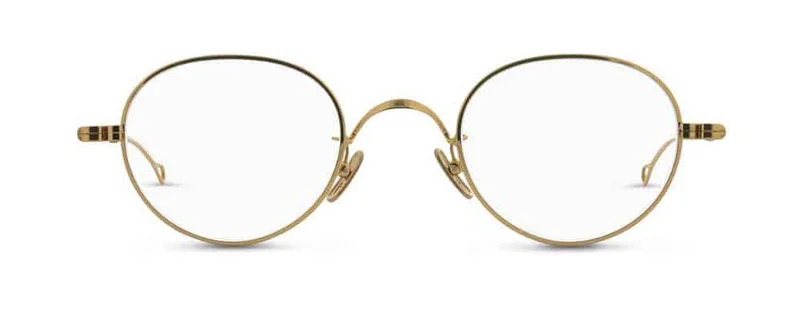
What makes the Classic endure is not celebrity association but the frame's fundamental rightness. The proportions are balanced. The weight is negligible — rimless construction means you are wearing little more than two lenses and a bridge. The materials age gracefully. And because Lunor has kept the model in continuous production for over thirty years, replacement parts and repairs are always available. It is the opposite of planned obsolescence.
Made in Germany, Built for Decades
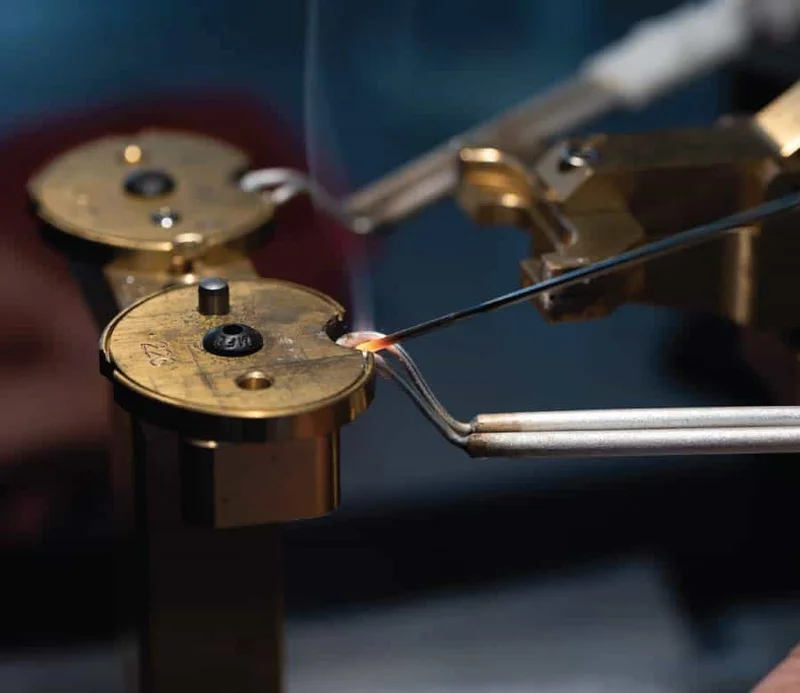
Lunor's commitment to regional production is not a marketing angle — it is a structural choice that shapes every aspect of the product. The LUMAG workshop's technical manager brings over fifty years of experience in spectacle manufacturing. Many of the tools used in production are not available commercially and are designed and partly manufactured in-house. Stainless steel frames are soldered at temperatures up to 830°C using a protective gas atmosphere, a process that produces joints of exceptional strength while eliminating nickel entirely — making every Lunor frame suitable for allergy sufferers.
The company is also a certified climate-neutral business, powering its operations with green energy, minimizing packaging waste, using recycled materials where possible, and offsetting remaining CO2 emissions through reafforestation projects in Colombia, Uruguay, and India. Their main building is nearly self-sufficient in energy production. Sustainability, like repairability, is not an add-on but a foundational principle.
Why Lunor Belongs in Your Consideration
In an era when most consumer goods are designed to be replaced, Lunor designs eyewear to be kept. Their collection of over 600 models — spanning acetate, stainless steel, titanium, and gold — carries no externally visible logos because, as the company puts it, "carriers are not advertising media." The frames speak through their construction, their comfort, and their longevity rather than through branding.
For patients who value craft over trend, substance over spectacle, and the quiet confidence of wearing something genuinely well-made, Lunor represents something increasingly rare in the optical world: eyewear built with the conviction that slower is better.
Explore our Lunor collection at The Last Optical in Montgomery, NY, or book a visit to experience the difference of genuine Black Forest craftsmanship in person.